> For the complete documentation index, see [llms.txt](https://docs.whalesync.com/llms.txt). Markdown versions of documentation pages are available by appending `.md` to page URLs; this page is available as [Markdown](https://docs.whalesync.com/previous-connectors/shopify/syncing-variants.md).

# Syncing variants

{% hint style="warning" %}
**Archived:** This connector is no longer offered by Whalesync. Existing syncs will continue to run, but future improvements and support will be limited. See [Previous Connectors](/previous-connectors.md) for more details.
{% endhint %}

## Syncing variants

{% hint style="info" %}
We suggest using our [Shopify Template Pack](https://www.whalesync.com/template-packs/shopify) which has the correct tables/fields pre-created
{% endhint %}

### **Summary**

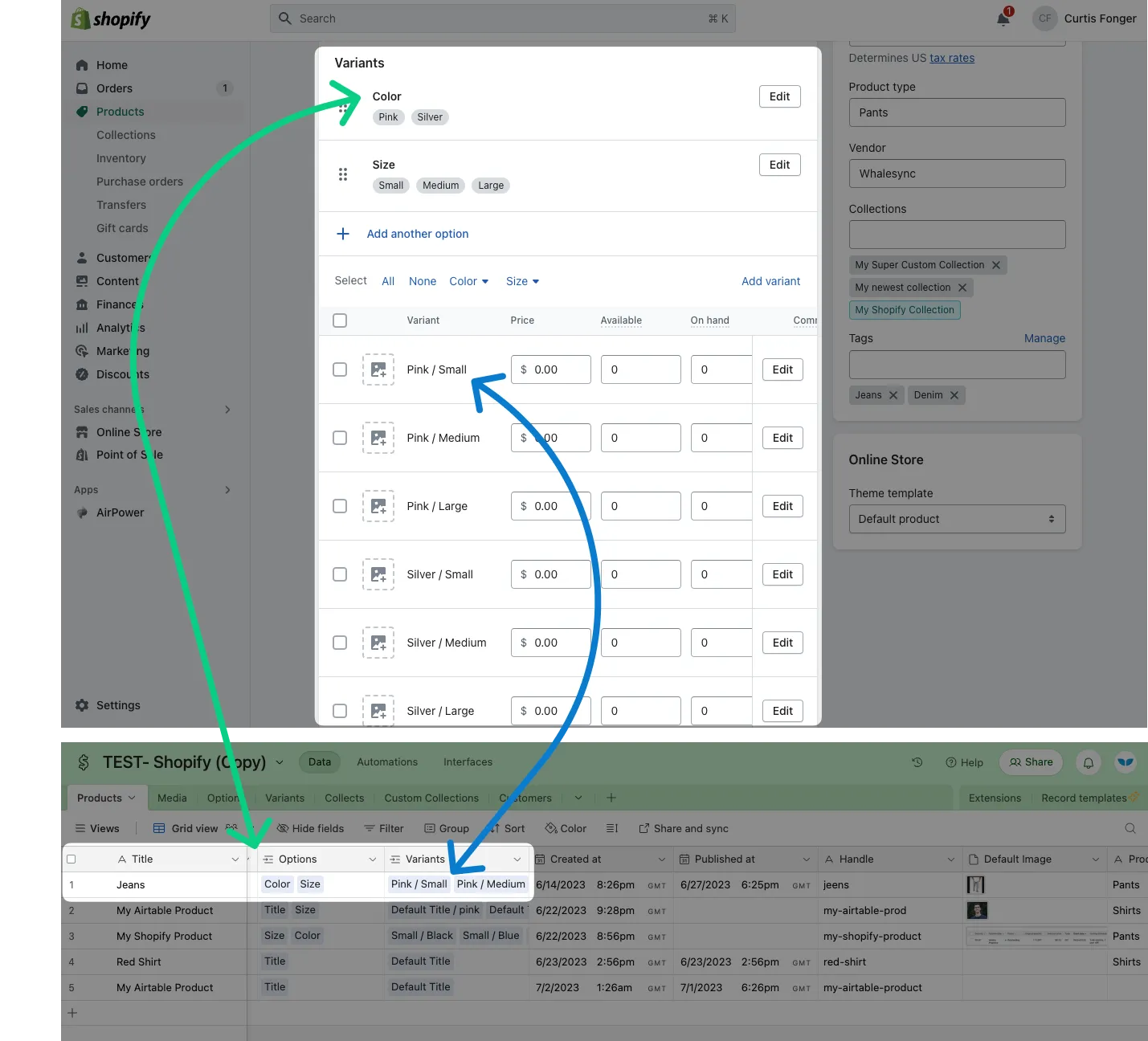
* In order to sync product variants, you'll need to create a Variants table and an Options table that are separate from your Products table
* You can then link a Product to those Options and Variants using a linked record (aka foreign key) field
* If you want to create new Variants from Airtable, you must create them by adding *Options* (just like you would in Shopify).

#### **Detailed Explanation**

<figure><img src="/files/tmiB2SIeS43XyYFld0rk" alt=""><figcaption></figcaption></figure>

1. In Airtable (or your other connected app), create a table called "Variants" and a table called "Options"
2. In your Products table, created linked records (aka foreign keys) from Product to Options and Variants

{% hint style="info" %}
If you want to create new Variants from Airtable, you must create them by adding *Options* (just like you would in Shopify). Editing the Variants table directly will not work.
{% endhint %}

### Limitations

{% hint style="warning" %}
Due to the Shopify API, Whalesync only supports up to 100 Variants. Syncing more than 100 Variants could have unexpected behavior.
{% endhint %}


---

# Agent Instructions
This documentation is published with GitBook. GitBook is the documentation platform designed so that both humans and AI agents can read, navigate, and reason over technical content effectively. Learn more at gitbook.com.

## Querying This Documentation
If you need additional information that is not directly available in this page, you can query the documentation dynamically by asking a question.

Perform an HTTP GET request on the current page URL with the `ask` query parameter, and the optional `goal` query parameter:

```
GET https://docs.whalesync.com/previous-connectors/shopify/syncing-variants.md?ask=<question>&goal=<endgoal>
```

`ask` is the immediate question: it should be specific, self-contained, and written in natural language.
`goal` is optional and describes the broader end goal you are ultimately trying to accomplish on behalf of the user. GitBook uses it to tailor the answer towards what is most useful for that goal.

The response will contain a direct answer to the question and relevant excerpts and sources from the documentation.

Use this mechanism when the answer is not explicitly present in the current page, you need clarification or additional context, or you want to retrieve related documentation sections.