Filters

Set filters on a table mapping to control which records sync. Change filters later by pausing the sync, and see how case sensitivity and percentages work.
Filters can be changed at any time
Section titled “Filters can be changed at any time”You can set filters when you create a table mapping, and you can change them later by pausing the sync.
Because a new filter applies to records that have already synced, Whalesync needs to look at every record again. When you turn the sync back on it runs another initial sync, and the preview tells you how many records will start syncing and how many will stop before anything is applied.
Filters sync the final update before future updates are excluded

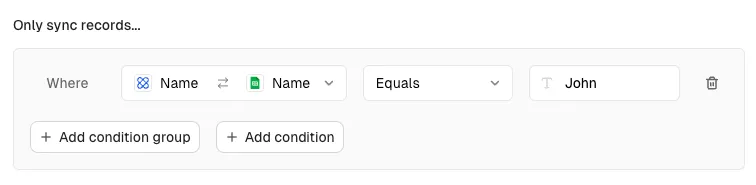
Section titled “Filters sync the final update before future updates are excluded”For instance, if you change a record from ‘John’ to ‘Sarah’ in Google Sheets, Whalesync will sync this last update to Affinity. After that final sync, changes to the now 'Sarah' record will be filtered out.
Will setting a filter delete any of my existing data?
Section titled “Will setting a filter delete any of my existing data?”No, adding a filter won’t remove existing data. Filters apply to any future updates.
Are filters case sensitive?
Section titled “Are filters case sensitive?”Yes.
How should I write percentage values?
Section titled “How should I write percentage values?”Percentage values should be written as numbers.
.CEU8i6bP_Z1WmV4q.webp)
What happens to records that stop matching when I change a filter?
Section titled “What happens to records that stop matching when I change a filter?”They stop syncing, and nothing is deleted. Anything Whalesync already copied stays where it is, and later changes to those records no longer travel between your apps. Deleting one of them in one app no longer removes it from the other.
Records that match the new filter start syncing.
Do I need to delete and rebuild my sync to change a filter?
Section titled “Do I need to delete and rebuild my sync to change a filter?”No. Editing the filter on the table mapping is all you need. Earlier versions of Whalesync did require rebuilding the sync, but filters can now be changed on a sync that is already running.