# Why do I need an ID column?

To enable two-way sync between Supabase and your other apps, Whalesync needs a way to uniquely identify each record in your Supabase database.

If your table already has a unique primary key, Whalesync will use it.

If not, Whalesync will automatically add a whalesync\_postgres\_id column to ensure each record can be tracked reliably.
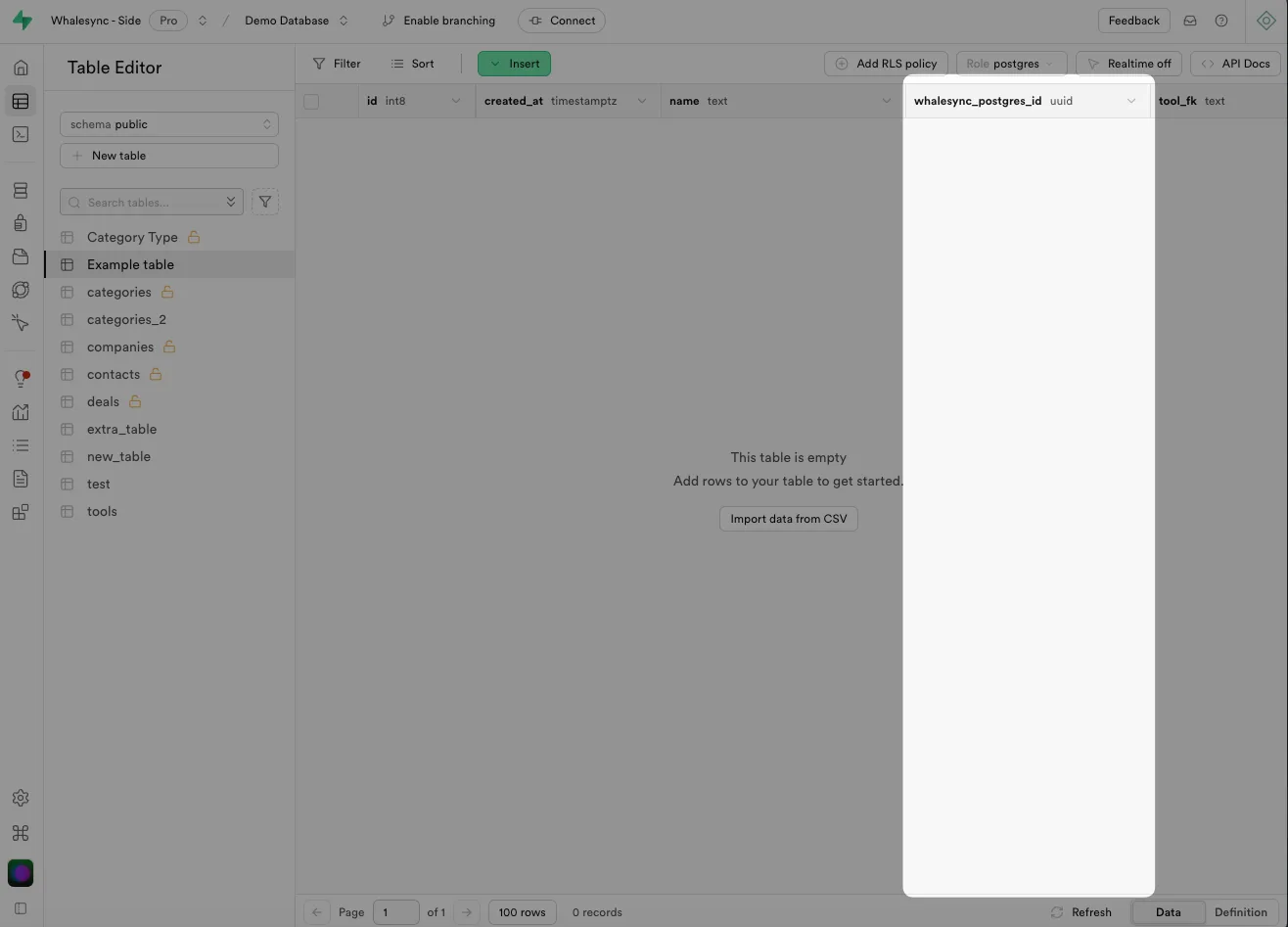
<figure><img src="/files/3IowpEKyLZg8zTpxieXl" alt=""><figcaption><p>What the automatically added "whalesync_postgres_id" column looks like in Supabase</p></figcaption></figure>

Alternatively, if you'd prefer to add your unique ID field manually, you can follow these steps:

{% content-ref url="/pages/kmoit3oru7EZjPKo3YS3" %}
[Adding default values to primary keys](/connectors/supabase/adding-default-values-to-primary-keys.md)
{% endcontent-ref %}


---

# Agent Instructions: Querying This Documentation

If you need additional information that is not directly available in this page, you can query the documentation dynamically by asking a question.

Perform an HTTP GET request on the current page URL with the `ask` query parameter:

```
GET https://docs.whalesync.com/connectors/supabase/why-do-i-need-an-id-column.md?ask=<question>
```

The question should be specific, self-contained, and written in natural language.
The response will contain a direct answer to the question and relevant excerpts and sources from the documentation.

Use this mechanism when the answer is not explicitly present in the current page, you need clarification or additional context, or you want to retrieve related documentation sections.
