# How to create a slug field in Airtable

Whalesync lets you sync Airtable with CMS apps like Webflow. These apps often require a unique "slug" field to ensure the pages you're creating are unique.

If you need to create a slug field in Airtable there are two options:

### 1) Manual (Single Line Text field)

If you'd like to type in slugs manually, you can use a single line text field.
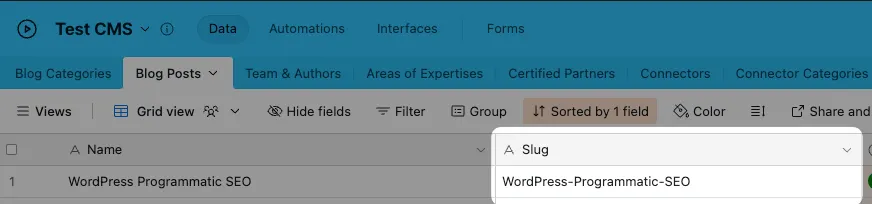
<figure><img src="https://2481481593-files.gitbook.io/~/files/v0/b/gitbook-x-prod.appspot.com/o/spaces%2FtLaMDbvbGOow76E8CnqW%2Fuploads%2FK6EA9RE7JaUDOFVdYHuL%2FManual.png?alt=media&#x26;token=256e4b7c-15a2-4309-8847-92a73aee84d3" alt=""><figcaption><p>Example Slug field with single line text</p></figcaption></figure>

### 2) Automatic (Formula field)

If you'd like to have your slugs created automatically (recommended!), you can use a formula field.
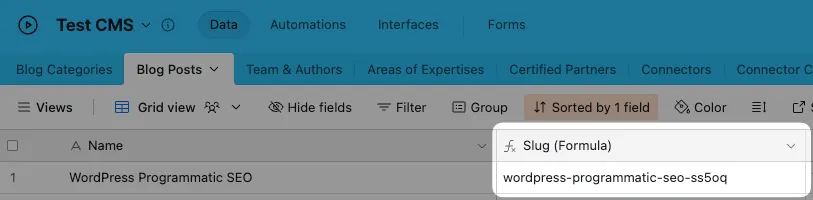
<figure><img src="https://2481481593-files.gitbook.io/~/files/v0/b/gitbook-x-prod.appspot.com/o/spaces%2FtLaMDbvbGOow76E8CnqW%2Fuploads%2FBK7f9WGYmSH2R0GE9VYb%2FAutomatic.png?alt=media&#x26;token=b852951d-1879-47af-87db-232eaa40d354" alt=""><figcaption><p>Example slug field with formula</p></figcaption></figure>

We recommend the following formula in Airtable to ensure slugs have the correct format:

```
LOWER(REGEX_REPLACE(REGEX_REPLACE(REGEX_REPLACE(TRIM({Name}), "[^a-zA-Z0-9- ]", ""), " ", "-"), "-+", "-") & "-" & RIGHT(RECORD_ID(), 5))
```

In Notion:

```
replaceAll(prop("Article Title"), "[^a-zA-Z0-9- ]|,| ", "-")
```


---

# Agent Instructions: Querying This Documentation

If you need additional information that is not directly available in this page, you can query the documentation dynamically by asking a question.

Perform an HTTP GET request on the current page URL with the `ask` query parameter:

```
GET https://docs.whalesync.com/resources/support/how-to-create-a-slug-field-in-airtable.md?ask=<question>
```

The question should be specific, self-contained, and written in natural language.
The response will contain a direct answer to the question and relevant excerpts and sources from the documentation.

Use this mechanism when the answer is not explicitly present in the current page, you need clarification or additional context, or you want to retrieve related documentation sections.
